Notable Cadets

Search Cadet Stories

Filter Cadet Stories

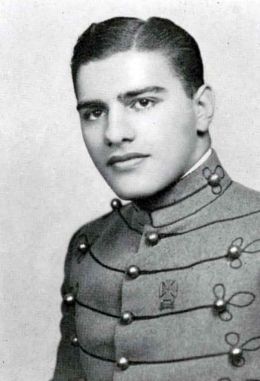
George Kassab
Class of 1939

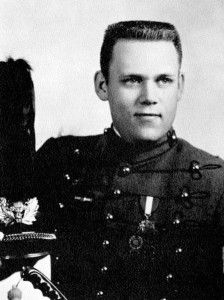
George Kassab ’39: Heroic Co-Pilot in Pacific Air Battle

530th Squadron, 380th Bomb Group

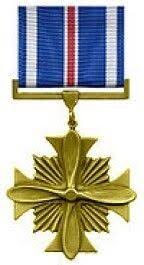
Distinguished Flying Cross for heroism during an air battle. In response to intelligence that a Japanese cruiser would possibly be in the vicinity, “Old Hickory," of the 530th Bomb Squadron piloted by Jack Bratton with George Kassab as the co-pilot, made the arduous flight from Fenton Field in Australia to Macassar in the Celbes. Although there was no cruiser, the Liberator (B-24 Bomber) was spotted and attacked by four Japanese Zeros (A6M Zero fighters). At first the Zeros unsuccessfully attacked with aerial burst bombs, and then reverted to more convention methods. The Liberator responded with 50cal fire. Despite severe damage, at the end of the ensuing fight, three Zeros were shot down. Lt. Kassab and the rest of the crew received the Distinguished Flying Cross for their “courageous service” during this air battle.

Share Link: http://pmc.widener.edu/pmc/legacies/cadets/george-kassab-39-heroic-co-pilot-pacific-air-battle 

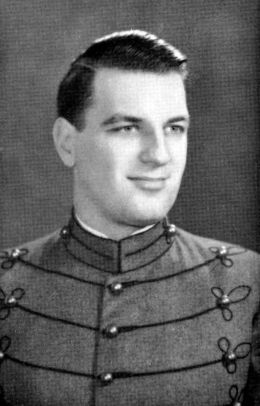
George Wilkens
Class of 1943

George Wilkens ’43: A Selfless Leader Lost in the Minefield

3rd Battalion, 398th Infantry Regiment, 100th Infantry Division, USAFE

Silver Star (Posthumously) for conspicuous gallantry while leading a combat patrol toward enemy territory at midnight on 1 March 1945. Lt. Wilkens encountered a hostile mine field and ordered his men to retrace their steps. When an alternate route was found, he instructed the members of the patrol to remain behind while he moved forward alone to reconnoiter. In so doing he was killed by the detonation of a mine, thus saving the lives of his comrades.

Share Link: http://pmc.widener.edu/pmc/legacies/cadets/george-wilkens-43-selfless-leader-lost-minefield 

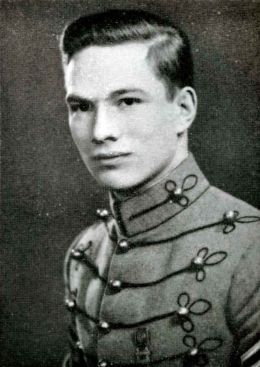
Henry T. Feige
Class of 1935

Henry T. Feige ’35: UDT Demolition Leader at Saipan and Guam

UDT 6, Amphibious Forces, US Pacific Fleet

Silver Star for gallantry and intrepidity in the face of enemy sniper, machine gun and mortar fire as he prepared the way for the amphibious landing of combat troops during the invasions of Saipan and Guam Islands.

In 1943, the Army and Navy established the UDTs (Underwater Demolition Teams). These specialized units were the forerunners of the Navy Seals. Each unit was comprised of volunteers who were excellent swimmers. Their training was extensive and exhausting, often consisting of grueling exercises that were conducted in the ocean off Hawaii and the swamps of Florida with the alligators and snakes. They learned to reconnoiter beaches and the waters just offshore, as well as locating reefs, rocks, and shoals that would interfere with landing craft. They also became skillful in the use of explosives to demolish underwater obstacles planted by the enemy.

Share Link: http://pmc.widener.edu/pmc/legacies/cadets/henry-t-feige-35-udt-demolition-leader-saipan-and-guam 

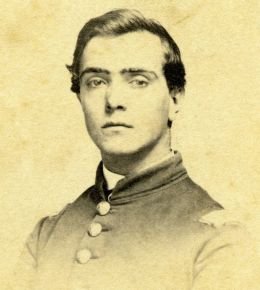
John L. Sparks
Class of 1861

John L. Sparks ’61: Steady Leadership at Chancellorsville

Company K, 1st Regiment, 1st Delaware Infantry Volunteers

Brigadier General Thomas A. Smyth of the 1st Regiment, Delaware Volunteers, wrote of the “bravery and conduct under heavy pressure” of Captain Sparks during the Battle of Chancellorsville. In October, after reorganizing a group of stragglers along Turkey Creek, near Bristoe Station, BG Smyth again wrote of the cool conduct and meritorious service of Captain Sparks.

The Medal of Honor was first authorized in 1861. It was the only medal awarded to soldiers for “gallantry and intrepidity” during the Civil War. Other acts of unmistaken gallantry were only recognized in the dispatches of unit commanders.

Share Link: http://pmc.widener.edu/pmc/legacies/cadets/john-l-sparks-61-steady-leadership-chancellorsville 

William A. Nurthen III
Class of 1943

William A. Nurthen III ’43: Gallantry from Germany to the Front Lines

1st Battalion, 20th Infantry, 10th Armored Division, USAFE

Silver Star for gallantry in action at Schwerdorf, Germany where he braved intense enemy artillery and small arms fire during a patrol.

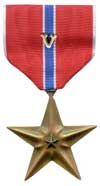
Bronze Star for heroism during an assault against a determined enemy which resulted in the recovery of eight disabled tanks.

Share Link: http://pmc.widener.edu/pmc/legacies/cadets/william-nurthen-iii-43-gallantry-germany-front-lines 

William J. Thompson
Class of 1953

William J. Thompson ’53: Rallying Forces Under Relentless Fire

MAAG-Vietnam, 47th Separate Infantry Regiment, ARVN

Silver Star for gallantry during an encounter between the lead units of the battalion against an enemy entrenched in a wooded area that dominated the field of battle. Captain Thompson rushed to the front and began to reorganize the dispersed Vietnamese units and those sent to retrieve four stalled armored scout carriers the dead and wounded. After successfully rallying the troops, he led them forward against the enemy, disregarding his own safety. Despite the constant enemy fire, he assisted these units in evacuating their wounded and dead.

Share Link: http://pmc.widener.edu/pmc/legacies/cadets/william-j-thompson-53-rallying-forces-under-relentless-fire 

George B. Christian, Jr.
Class of 1896

George B. Christian, Jr. ’96: The President’s Trusted Confidant

After completing high school in three years, George B. Christian, Jr., left Marion Ohio and enrolled at Pennsylvania Military College. He was a gifted student, earning the title of distinguished Cadet for earning a spot on the Merit List. Colonel Frank Hyatt wrote that “Mr. Christian is a cadet of high character and excellent intellectual attainments.” In 1896, he graduated with a Civil Engineering degree. He then returned to Marion and worked for his father at the Norris & Christian Stone and Lime Company.

Christian was also the next-door neighbor of Warren and Florence Harding. At an early age he delivered the Star newspaper, owned and operated by Harding. When Harding ran for the U.S. Senate in 1913, Christian was very involved in the campaign. One of the first decisions Harding made as senator-elect was to hire Christian as his personal secretary. As Harding’s alter ego this association continued throughout Harding’s presidency.

As Secretary to the President, Christian was the precursor of today’s White House Chief of Staff. He would act as the buffer between the President and public, keeping the President’s schedules and appointments, managing his correspondence, communicating to the press and managing the White House staff, which consisted of 31 people during the Harding Presidency.

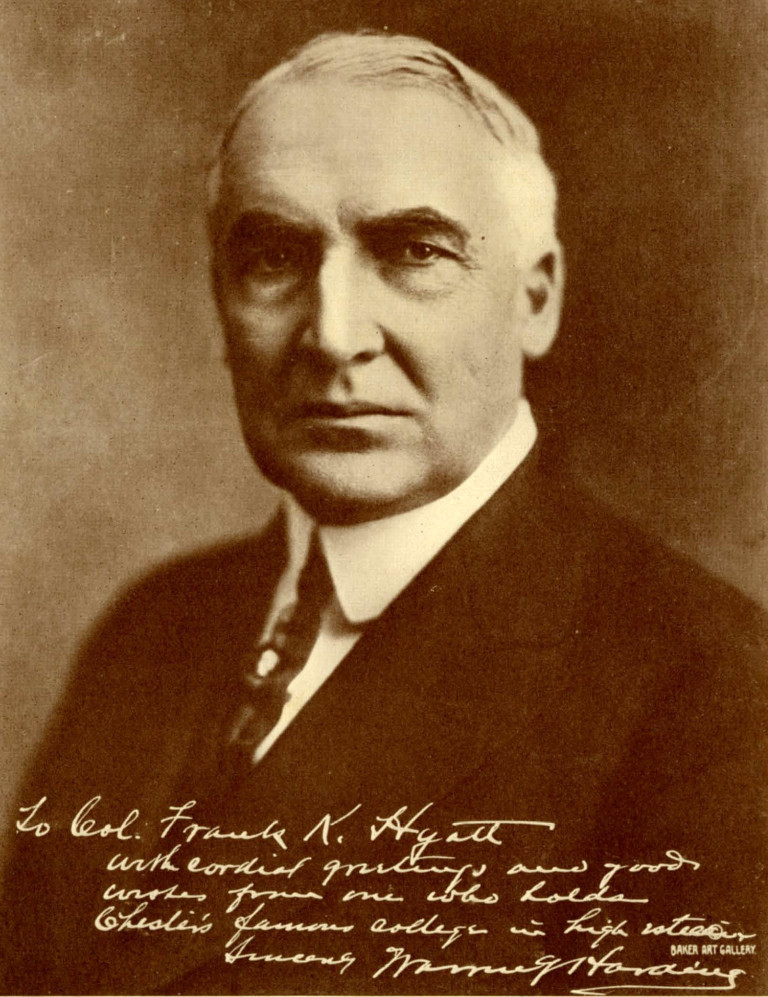
In February, 1920, PMC held its annual recognition of Washington’s birthday. Then Senator Harding, accompanied by Christian, was the featured speaker and was awarded the degree of Doctor of Laws. Harding’s address was described as a “tribute to PMC.” Although Harding declined an invitation to attend the Centennial Commencement Ceremony, Christian sent a photo of the President inscribed with the comment “… from one who holds Chester’s famous college in high esteem.”

Christian was devastated after the unexpected death of Harding in 1923. In an interview with the New York Times he commented: “For nearly nine years I worked beside him and my present sorrow is somewhat assuaged by the feeling of satisfaction of having been permitted to serve a great president, a most humane and considerate chief and the finest friend as has ever been given a man to have.” Although he assisted with the transition of President Coolidge, Christian turned down the President’s offer to remain.

For the next few years, Christian devoted his time to working with the Harding Memorial Association, which was formed shortly after Harding’s death to plan and raise money for the Harding Memorial. He had also planned on writing a biography about Harding and his own experiences, but he developed glaucoma, with eventually robbed him of his sight. By 1930 he was inactive and his health began to fail. died in 1951.

Share link - http://pmc.widener.edu/pmc/legacies/cadets/george-b-christian-jr-96-presidents-trusted-confidant 

David Wilson
Class of 1966

David Wilson ’66: Valor at the Mang Yang Pass

David Wilson was attracted to PMC by its military education, discipline, and development of leadership skills. He quickly assimilated to life at PMC and was considered to be a model Cadet. He promoted esprit-de-corps and motivation among his classmates. He was commissioned during the Commencement Exercises of 1966.

On 31 January 1968, First Lieutenant David Wilson commanded a supply convoy of mostly 5-ton tractor trailers that was returning to An Khe from Pleiku, RVN. At the foot of the Mang Yang Pass, a superior enemy force, supported with heavy weapons, ambushed the convoy. Many of the vehicles in the convoy had stopped and were subject to intense enemy mortar and small arms fire. At the moment the ambush was triggered, 1LT Wilson’s command vehicle was just forward of the kill zone. Although he was out of danger, he immediately returned to the kill zone and, with complete disregard for his own safety, 1LT Wilson commenced leading his men to safety. Then, while directing the convoy to safety, his jeep sustained a direct hit from a mortar round.

David Wilson was posthumously awarded the Silver Star and Purple Heart for his outstanding leadership and heroism for saving the lives of many of his men. Six Cadets served as pallbearers and the Commandant’s Staff and others from PMC attended the services. In December of 1968, the Bien Hoa Cantonment Area was dedicated to his memory. During the ceremonies, Brigadier General D.A. Richards, Commanding General of II Field Force Transportation units, stated: “David Wilson knew the meaning of valor…the meaning of caring…the meaning of responsibility, and to me, David Wilson represents the hope for the future!”

Silver Star for his outstanding leadership and heroism while saving the lives of many of his men.

Share Link: http://pmc.widener.edu/pmc/legacies/cadets/david-wilson-66-valor-mang-yang-pass 

Evans Kayser
Class of 1965

Evans Kayser ’65: Gallantry in Vietnam

Evans Kayser entered PMC because of the recommendation of Norman Goldberg who, together, would be in the Class of 1965. In Kayser’s view, it “was one of the best decisions” he ever made. As a member of HQ Company (the Band) and a trombone player, he participated in the Boardwalk Bowl in Atlantic City and the PMC 1st Place Award-Winning National Marching Band Competition at the New York World’s Fair. His Army aviation career began when he participated in the ROTC Flight program where he learned to fly at the Wilmington, DE, airport. After graduation, he attended Rotary Wing Flight School (training for helicopter pilots) before deploying to Vietnam. In Vietnam, Kayser served as Pilot with Delta Troop, 3/5 Armored Cavalry. D Troop acted as a separate unit as a Quick Reaction Force, to work in tandem with infantry brigades on major assaults and other missions.

Late in the afternoon of June 19, 1967, two UH-1C helicopter gunships, piloted by 1st Lt. Kayser and Capt. Paul Osterlin, responded to an urgent call to support units of the 2nd Brigade, 9th Infantry Division that had been ambushed by the Viet Cong. As they approached the battle, radio communication with the Brigade was difficult due to the casualties, ground fire, and chaos. The two helicopters immediately engaged the enemy firing all of their weapons systems (two mini-guns and two 7 round 2.75 rocket pods plus two M-60 machine guns). After several firing passes, an emergency UHF radio call from the Brigade declared a tactical emergency and requested additional fire support from any weapons-capable aircraft. The combined response from helicopter gunships and Air Force tactical aircraft was remarkable. Kayser’s helicopter only left the battle to refuel and rearm at the airstrip at Tan An (a few minutes away) and return to the firefight. As the battle continued, Kayser continued to effectively fire on the enemy as well as escorting medical evacuation helicopters in and out of the area. Despite sustaining damage to his aircraft, Kayser continued to support the ground troops until daybreak on June 20.
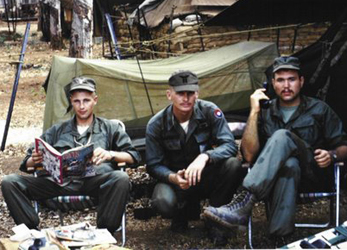
Capt Sam Slaughter, commander of the fire team, wrote: … this was one of the most complicated and difficult combat operations I have ever supported while under fire. Although it took 44 years and the help of Congressman Tim Scott of South Carolina, Evans Kayser was awarded the Silver Star Medal in 2011.

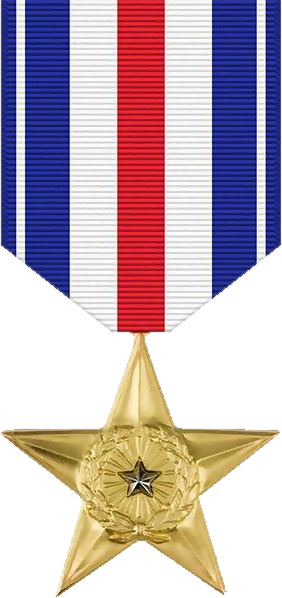
Silver Star for gallantry in action while responding to a distress call from an infantry company that had been ambushed by a large enemy force. First Lieutenant Kayser immediately attacked the enemy and when his ammunition was exhausted and fuel was low, he continued to mark the location of the enemy with smoke. After tactical air support was engaged, 1LT Kayser made repeated trips to a nearby air field to rearm and refuel. He then continued to escort supply and medical evacuation aircraft. His efforts in holding the enemy back and supporting the ground troops allowed them to maneuver to a more defensive position.

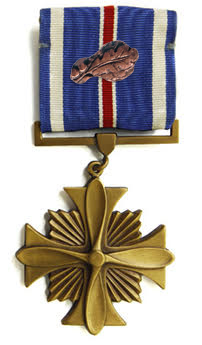
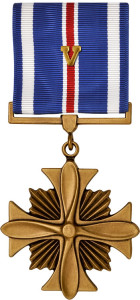
Distinguished Flying Cross for heroism while flying a routine river patrol near Tan An he reported encountering an infantry unit under fire from a superior Viet Cong force that needed air support. He fly to the area of the endangered infantry unit and launched a grenade and rocket attack on the enemy. He continued to attack and provided continuous fire on the enemy.

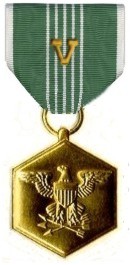
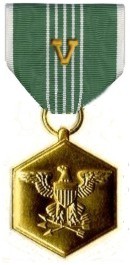
Army Commendation Medal for for heroism while flying an armed helicopter in support of ground operations.  Upon learning of a heavy ground attack against an Army of Vietnam outpost, 1Lt Kayser rushed to the area and made several low level gun runs resulting in the attack by a numerically superior enemy force being broken and the enemy fleeing.
Watch Congressman Tim Scott Present Evans Kayser with the Silver Star: https://www.youtube.com/watch?v=o26po7yIAko 

Share Link: http://pmc.widener.edu/pmc/legacies/cadets/evans-kayser-65-gallantry-vietnam 
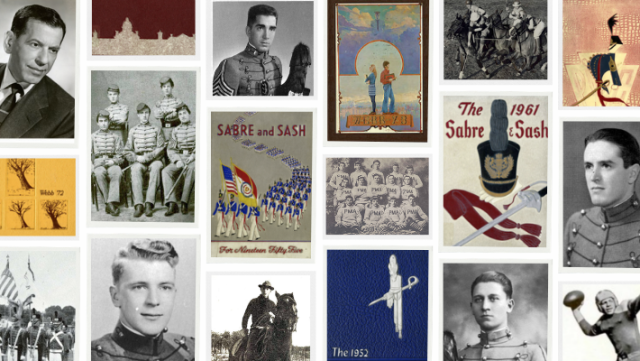
John H. Tilelli
Class of 1963

John H. Tilelli Jr. ’63: A Soldier’s Soldier

On the recommendation of a PMC alumnus, John Tilelli’s family visited the college. Impressed by the “rigor, discipline of study and environment” of PMC, John Tilelli applied, was accepted and enrolled. His Rook year was difficult, but as he became acclimated to the procedures and the expectations of the academic work, he improved. As a cadet, John quickly became an outstanding example. With some luck and hard work he never walked a tour and graduated as a Distinguished Military Graduate. To this day he credits the Corps of Cadets, with its camaraderie and the leadership education, putting him on the path to success.

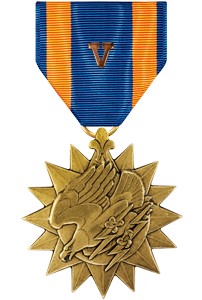
After graduation, he began a career in the Army in a variety of diverse and vital positions. First in Vietnam as a Company Commander in the 18th Engineer Brigade and as the District Senior Advisor to Team 84, Commanding General the 1st Cavalry Division during Operations Desert Shield and Desert Storm, and four times in Germany. Tilelli’s staff assignments include the Pentagon, as the Assistant Deputy Chief of Staff for Operations and Plans, then as Deputy Chief of Staff for Operations and Plans and Vice Chief of Staff of the Army. He concluded his active duty career as Commander in Chief of the United Nations Command, Republic of Korea / U.S. Combined Forces / U.S. Forces Korea. Tilelli is a highly decorated officer, wearing the Combat Infantryman Badge and the Parachutist Badge along with decorations. He was the recipient of the Distinguished Service Medal (with three Oak Leaf Clusters), the Legion of Merit, the Bronze Star with “V” Device (with two Oak Leaf Clusters), the Defense Distinguished Service medal, the Meritorious Service Medal (with three Oak Leaf Clusters), the Air Medal, the Army Commendation Medal (with two Oak Leaf Clusters), and the Vietnamese Cross of Gallantry with Silver Star and Palm.

For more than 30 years, John Tilelli served his country in the armed forces with integrity and distinction. His combat leadership and management skills have made the U.S. Army an improved organization. This sentiment was echoed on the floor of the House of Representatives in 2000.

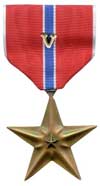
Bronze Star for heroic action while relieving a unit pinned down by heavy small arms and mortar fire, Major Tilelli, who had positioned himself on top of the command APC, ignored the impact of mortar rounds and hail of small arms surrounding him while directing the assault on the enemy.

Listen to General John Tilelli Jr., USA (Ret) speak on Veterans Day at the Vietnam Memorial Wall. November 11, 2012: https://www.youtube.com/watch?v=rnCnfWCoi2s 

Share Link: http://pmc.widener.edu/pmc/legacies/cadets/john-h-tilelli-jr-63-soldiers-soldier 

Joseph P. McCaffery
Class of 1927

Joseph P. McCaffery ’27: Marine Raider in the Pacific

Joseph P. McCaffery ’27 attended PMC along with his brother, Hugh McCaffery ’24. Because of his size and older brother, he was known as “Little Joe.” While at PMC, he was recognized as a marksman and the quarterback on the football team. “Babe” Buono ‘26, one of McCaffery’s roommates, stated that, “When it came to courage and transferring that courage to others, Joe had no equal.” After graduation, McCaffery was commissioned as a 2nd Lieutenant in the Army Reserves, but resigned to accept a commission in the Marine Corps Reserves.

After serving at Pearl Harbor, Shanghai, San Diego, and Quantico, McCaffery joined the Marine Raiders. The Raider battalions were a special mission force that were lightly armed and intensely trained to spearhead larger amphibious landings on beaches (thought to be inaccessible); conduct raids requiring surprise and high speed, and operate as guerrilla units for lengthy periods behind enemy lines. When a battalion lost its commander on Guadalcanal, McCaffery assumed command. After leading his troops though a dense jungle to safety, he was immediately promoted to Lieutenant Colonel and assigned to the 1st Marine Raider Regiment. In the Munda-Rendova campaign, he led a 15-mile trek through a swamp and wiped out a Japanese garrison, which had been caught completely by surprise. Next came the landing at Bougainville.

For this operation, McCaffery took over the Second Raider Battalion. The landing encountered a Japanese crossfire, which caused havoc and disorder within the assault waves. McCaffery landed with the first wave of Raiders. As the Marines cleared the beach, they were stopped by machine-gun fire from a well-concealed bunker. While leading the Marines forward, McCaffery was struck four times in the chest. Despite the best efforts of the corpsman and Battalion surgeon, he died.

His fellow soldiers described him as a brilliant officer, kind and loyal friend, and courageous hero. He was awarded the Silver Star Medal for his superior leadership between November 1942 and January 1943. In May 1944, McCaffery was awarded the Navy Cross posthumously for “extraordinary heroism while in command of the 2nd Marine Raider Battalion in action against enemy Japanese forces.” In 1945, the USS McCaffery, a navy destroyer, was commissioned in his honor.

Silver Star for conspicuous gallantry and intrepidity as Commanding Officer of the First Battalion, Eighth Marines, Reinforced, in action against enemy Japanese forces on Guadalcanal, Solomon Islands.

2nd Raider Battalion, 4th Marines, FMF Pacific
Navy Cross for extraordinary heroism and distinguished service in action against enemy Japanese forces during the landing attack in the Cape Torokina Area, Bougainville Island, British

Share Link: http://pmc.widener.edu/pmc/legacies/cadets/joseph-p-mccaffery-27-marine-raider-pacific 

Thomas Merendino
Class of 1941

Thomas Merendino ’41: Heroism on Omaha Beach

Thomas Merendino ‘41, often called Tommy, was known as an athlete, scholar and gentleman at PMC. He was a versatile athlete and played football, basketball, and baseball. Yet, it was his smile and good humor that his classmates remembered.

The D-Day mission of the 16th Infantry Regiment was to land on Omaha Beach, the most heavily fortified of the five beaches, reduce the beach defenses, and secure the Beach two hours before dark. As the regiment’s landing craft approached the Beach, they came under intense fire. As the assault wave slowly built up a firing line, Company B, led by Captain Merendino, landed ten minutes after the first assault wave. The scene was described as chaotic and disorganized. As landing craft dropped their ramps, men were killed and wounded as they attempted to get out of the boats. Others were hit as they struggled through the surf or tried to run across the sand weighted down with waterlogged equipment.

Merendino disembarked from the landing craft in the initial assault wave and, with complete disregard for his own safety, organized the men who were struggling in the water and led them through the intense enemy fire to the shore. Upon reaching the shore, he refused to take cover and again organized an assault group for further advance. Fully exposed to the sweeping fire from enemy pillboxes and machine gun nests and a constant target for the snipers on the hill, he personally led the charge up the slope and overran a German stronghold.

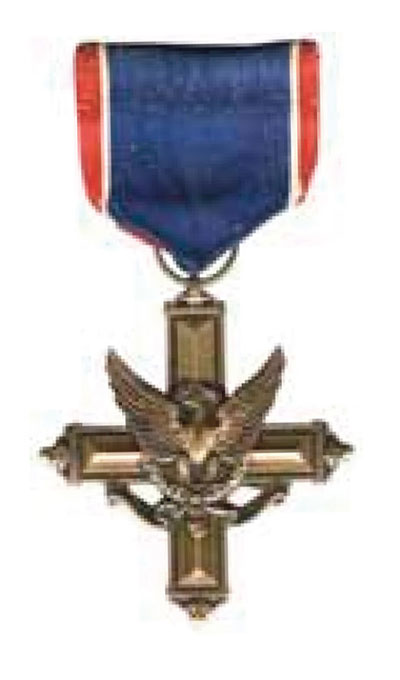
General Eisenhower visited the First Division on July 2nd and pinned awards for heroism on twenty-five First Division heroes, including Merendino, who received The Distinguished Service Cross Medal. This was not his first act of valor. During the Oren offensive in Algeria, the (then) Lieutenant Merendino directed the fire of a 105mm self-propelled howitzer on an enemy stronghold. When this failed, he ordered the howitzer to ram the German stronghold. He then dismounted the vehicle and charged the German stronghold and captured 20 Germans. This act of bravery earned him The Silver Star Medal.

Share Link: http://pmc.widener.edu/pmc/legacies/cadets/thomas-merendino-41-heroism-omaha-beach 

William Pollock
Class of 1935

William “Reds” Pollock ’35: All-American Excellence

In 1933 the PMC eleven made the trip to West Point to play what many consider to be the finest football game ever played by the Cadets. At the time, West Point was a powerhouse. PMC held the undefeated and untied Army eleven to two last quarter touchdowns. This game was also a prelude to the following season.

During the 1934 season, William “Reds” Pollock demonstrated why he is considered to be possibly the greatest PMC player. Although he played all 4 years, the team and “Reds” earned a national reputation in 1934. At the end of a formidable schedule, the team was unbeaten. Although PMC was tied twice during the season, only one team crossed the PMC goal line. That season the Cadets scored 165 points.

Throughout the season sports writers continually praised the team and “Reds” Pollock. The New York American said, “The PMC team was equipped with a great passer, kicker, blocker and runner in Reds Pollock.” The Philadelphia Public Ledger wrote: “Not only in kicking did Pollock demonstrate that he is of All-American caliber, but his passes were deadly, his blocking clean, and he tackled ferociously. The qualifications of an All-American back have always been from an offensive viewpoint, kicker, passer and runner. Pollock has two outstanding additional features – he is an efficient blocker and a wonderful defensive back.”

PMC    0    Rutgers    0
PMC    0    Bucknell    0
PMC    20    West Chester    0
PMC    25    St. Joseph’s    0
PMC    12    University of Delaware    0
PMC    26    Juniata    0
PMC    39    Susquehanna    0
PMC    31    University of Baltimore    0
PMC    12    Lebanon Valley    7

Share Link: http://pmc.widener.edu/pmc/legacies/cadets/william-reds-pollock-35-all-american-excellence 

Carl Schaubel
Class of 1930

Carl Schaubel ’30: Coach, Officer, and Leader

What drew Carl “Jimmie” Schaubel to PMC in the fall of 1926 was his interest in horses. His classmates soon recognized that his “witticisms and easy-going manner” made his personality a strong attribute. Schaubel was a hard worker in the classroom and played shortstop on the baseball team. At the same time he learned to ride and developed into a fine polo player under the tutelage of Frank Hyatt. Schaubel commented that being a member of the undefeated polo team in 1930 was a highlight of his time as a Cadet. As a polo coach, he was considered to be one of the best in the country.

In 1930 Schaubel was awarded a Bachelor of Economics degree and was asked to remain at PMC as the coach of the polo team and assistant professor of military science and tactics. After spending 10 years in the army reserves, Mr. Schaubel volunteered for active duty in 1940. His first assignment was at PMC in large part due to Frank Hyatt. After a similar assignment at the College of William & Mary, Schaubel was ordered to report to the commanding general of the European Headquarters in London. After the invasion of Normandy, Schaubel traveled through Northern France and Germany as part of an advance team for General Eisenhower’s Staff. After the war, he was sent on a special mission, which included travels throughout the Middle East and all the countries behind the Iron Curtain including Russia. He was then transferred to the Pentagon.

After leaving the Army, Schaubel worked at the Dunlap Printing Company in production and then as sales manager. In 1956 he became president of the company. In 1964, he returned to PMC as a staff vice-president and retired in the 1973.

Share Link: https://pmc.widener.edu/pmc/legacies/cadets/carl-schaubel-30-coach-officer-and-leader 

Larry Liss
Class of 1963

Larry Liss ’63: Rescue at Cau Song Be

Larry Liss’ first exposure to PMC was as a high school senior at the 1958 Mother’s Day parade. He watched from the stadium as the Corps marched onto the field. He told his father “I’ve got to go to this school.” Larry adapted to balancing his academic and cadet life very well. As a "Rook” he joined Pershing Rifles, which was a demanding experience. Larry graduated as a Distinguished Military Student in 1963 and was commissioned a second lieutenant in the Regular Army. While stationed in Germany, he volunteered for helicopter flight training. After primary training, he was sent to the Army Aviation Center and learned to fly the Huey. Larry graduated from flight school in the fall of 1966. Within 30 days, he was in South Vietnam.

On May 14, two unarmed UH-1 “Huey” helicopters had landed at an outpost called Cau Song Be, near Tay Ninh City. Co-Pilot Captain Larry Liss along with Warrant Officer Tom Baca, learned that a South Vietnamese company had been surrounded by the 273rd North Vietnamese Army regiment. Along with another Huey they responded by taking off to rescue the South Vietnamese. The South Vietnamese had been ambushed along a narrow road with trees and bamboo growing along the roadside. As the helicopters hovered, it was clear that there was not clearing, so they chopped their way through the bamboo and other vegetation using the rotor blades.

Almost immediately South Vietnamese soldiers started to climb aboard both helicopters. Disregarding his own safety, Liss left the cockpit and assisted evacuees onto the helicopter during several landings. Later, the aircrews recalled seeing soldiers being killed on the aircraft while they were boarding the helicopters or already had boarded. The valiant helicopter crews made numerous trips, and rescued 80 to 100 South Vietnamese soldiers and the U.S. Special Forces adviser. In addition, information about the location of the enemy force likely prevented the outpost at Cau Song Be from being overrun. His courageous actions during the Cau Song Be rescue mission earned Liss the Distinguished Flying Cross for Valor.

Silver Star

Silver Star for heroism and gallantry in action while participating in aerial flight in an unarmed helicopter in support of a Civilian Irregular Defense force under attacked by a numerically superior force on May 14, 1967 near Cau Song Be, Republic of Vietnam.

Disregarding his own safety, Captain Liss diverted from his routine transportation mission to fly in reinforcements and evacuate the wounded from the friendly force. To successfully land Captain Liss used his rotors to clear an area in the dense canopy to land his vehicle. This was an extremely hazardous undertaking. He successful landed with reinforcements and evacuated the wounded. He repeated his cycle several more times, despite a shrinking perimeter, enemy fire and lost communications with supporting tactical air. Due to chaos on the ground on the last two trips, it was vital that control be established and he exited the aircraft, organized the situation, and expedited the extraction of the wounded at great personal risk. On the last trip, with 18 soldiers on board, far in excess of weight guidelines, he nevertheless cleared the LZ and flew to a supporting aid station. Captain Liss’ heroism, determination, and ingenuity contributed to the successful outcome of the situation and reflect great credit on him and Field Force Il, United States Army Vietnam.

View Rescue at Cau Song Be On YouTube at http://m.youtube.com/watch?feature=player_embedded&v=rhdvG1X2AU4&desktop_uri=%2Fwatch%3Ffeature%3Dplayer_embedded%26v%3DrhdvG1X2AU4 produced by the Angelo Group.

Share Link: https://pmc.widener.edu/pmc/legacies/cadets/larry-liss-63-rescue-cau-song-be 

Robert Tumbelston
Class of 1907

Robert T. Tumbelston ’07: Innovation Behind the Plate

In 1902, Robert T. Tumbelston began his “rooky” year at PMC. Although he studied Civil Engineering, he was always fond of athletics and baseball. For five years he “showed great ability and was at once put into the catcher’s box.” In 1905, Tumbelston wore shin guards during the season and may be the first player to wear this type of equipment. They were originally football shin guards with the buckles at the side and made out of rattan and canvas.

Although catchers were expected to take their lumps without grumbling, shin guards were not part of the equipment catchers typically wore. At the time most catchers only wore a mask and had a glove designed merely to take the sting out of pitches. Baseball equipment, however, was quickly becoming a necessary part of the game. Catchers in particular sought to avoid injuries to their hands, face, head, chest and shins.

In April 1907, baseball’s New York Giants opened the 1907 season against the Philadelphia Phillies at the Polo Grounds. Baseball Hall of Famer Roger Bresnahan played catcher and as he squatted behind the plate he drew the howls of spectators with his new look. His appearance looked more like a goaltender than a catcher in his pair of thickly upholstered shin guards, chest protector and mask.

Share Link: https://pmc.widener.edu/pmc/legacies/cadets/robert-t-tumbelston-07-innovation-behind-plate 

Dennis Isom
Class of 1966

Dennis Isom ’66: Ambush in the Plei Trap Valley

Dennis Isom ‘66 was a hard person not to like at PMC. Although small in stature, he was a member of the Ranger Platoon and was remembered for rappelling off the roof of Terrell Hall. He was mentally tough and processed the qualities of being a leader. Upon graduation he was commissioned and joined the infantry.

The Army’s 4th Infantry Division began Operation Wayne Grey in early March 1969. Its mission was to prevent the 66th North Vietnamese Army Regiment from moving into South Vietnam’s Central Highlands, particularly in Kontum province near the Cambodian border. The lead element for the operation was the third battalion, 8th Infantry, comprised of Companies A, B, C, and D. They were deployed by helicopter assault into the Plei Trap Valley, an area northwest of Pleiku and Kontum.
On the morning of March 3, helicopters dropped A Company, led by Captain Dennis Isom, into the valley to prepare for a night patrol. As the company began to set up their night location, the third platoon, under the command of Lt Buddy Williams, was ordered to go further along the trail.  As the men made their way along a ridgeline, they killed two NVA soldiers, and that’s when the firefight began. A machine gun opened up at close range, killing one soldier and wounding another. Williams and his men took cover and returned fire, but more NVA joined in the fight. When Isom learned of the engagement, he rushed to reinforce the platoon with elements of A Company. Isom immediately calls for air support. At this the radio operator was wounded. When Isom went to his aid, he was killed instantly by a burst of machine gun fire across the chest.

Share Link: https://pmc.widener.edu/pmc/legacies/cadets/dennis-isom-66-ambush-plei-trap-valley 

Edmund Cook
Class of 1906

Edmund "Ned" Cook '06: PMC’s First Casualty in World War I

When World War I broke out, Edmund “Ned” Cook, ex-cadet, Class of 1906, felt it was his patriotic duty to fight for the Allies. He traveled to England and enlisted. He became a member of the 4th Battalion of the British Grenadier Guards, the oldest and most famed infantry regiment in England.

The regiment was in France and a major part of the Allies offensive in 1917. Ordered to attack just before dawn on August 10, Cook went “over the top” dodging from shell hole to shell hole. German machine guns fired an unrelenting barrage on them on the Grenadiers. “Ned” Cook was struck and went down, wounded in the abdomen and legs. Refusing care during the attack, Cook told his comrades to “carry on, you fellows.”

Stretcher-bearers following the attack picked up the injured man who had refused the aid of his brother Grenadiers. They carried him to the rear where he died a few days later at Casualty Clearing Station Number 62.

“Ned” Cook was the first PMC casualty of the war. Sometime later, his wife wrote to Colonel Hyatt that Cook was an honor to PMC’s “teachings and guidance and you may be proud of your good soldier.”

Share Link: https://pmc.widener.edu/pmc/legacies/cadets/edmund-ned-cook-06-pmcs-first-casualty-world-war-i 

Henry Clay Robinett

Henry Clay Robinett: Union Artillery, Battle of Corinth

In 1861, Henry Clay Robinett, like others before him, Robinett distinguished himself by the defense of “Battery Robinett,” a Union artillery battery, during the Battle of Corinth in Mississippi. Unlike many who returned to civilian life after the Civil War, Robinett pursued a career in the regular Army. That career, however, was marred by ever increasingly erratic behavior that ended in his suicide just three years after the war while still on active duty – the result of complex psychological problems that still manifest themselves in our military today.

The PMC “Battery Robinett,” was named in Robinett’s honor. During each football game, the Battery fires its cannon.

Share Link: https://pmc.widener.edu/pmc/legacies/cadets/henry-clay-robinett-union-artillery-battle-corinth