Collage of Pennsylvania Military College cadets and archived yearbooks documenting student life and traditions

Notable Cadets

Search Cadet Stories

Filter Cadet Stories

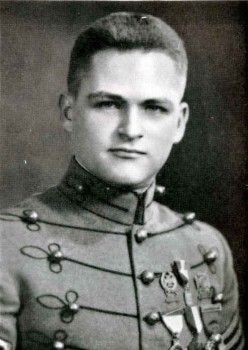
Thomas Anderson
Class of 1942

Thomas Anderson ’42: A Four‑Time Silver Star Leader in Two Wars

When “B” Company Commander Thomas Anderson graduated from PMC in 1942, he was considered to be a no nonsense Cadet and a “True Leader.” He had a commanding voice, a squared-away military appearance and was an expert at handling those Cadets around him. During his four years, he was awarded the Dunlap Memorial Rifle Trophy and the Oliver Revolver Medal for his marksmanship. His amiable manner also kept him busy with several social pursuits, including the 3rd Class (Sophomore) and 2nd Class (Junior) Dance Committees and the Sabre and Sash (Yearbook).

Anderson was assigned to the 26th Infantry Regiment, nicknamed “The Blue Spaders”, 1st Infantry Division. He focused on preparing for the amphibious invasion of North Africa. First Lieutenant Anderson and his unit landed on the beaches west of Oran, in northwest Africa. The inexperienced American troops encountered stubborn enemy resistance. Anderson’s unit came under constant and effective machine-gun and small-arms fire. Anderson was awarded The Silver Star Medal for his leadership and bravery in leading his men to the successful completion of their mission.

Moving inland, the 1st Infantry Division took up defensive positions in the Kasserine Pass, a wide gap in the Atlas Mountains. Elements of Rommel’s Afrika Korps launched a counter-attack against the 1st Infantry in order to regain control of Tunisia. During the German assault, Anderson led a machine gun squad in the destruction of a well-concealed sniper nest. For his outstanding leadership and tactical skill, Anderson was awarded The Oak Leaf Cluster to The Silver Star Medal (Second Award).

On D-Day, the 26th Regiment landed on Omaha Beach. After landing on “Fox Green Beach,” Anderson, now a Captain and the Commanding Officer of A Company, 1st Battalion, 26th Infantry Regiment, was ordered to take the high ground west and southwest of the Port-en-Bessin, to include Mount Cauvin. Although little is recorded about this engagement, Anderson was awarded The 2nd Oak Leaf Cluster to The Silver Star Medal (Third Award).

During the Korean War, in late May 1951, the 7th Infantry Regiment launched a counter-attack to a Chinese advancement. The goal was to capture key hills and passes near Soksa-ri, Korea, and push the enemy back. During the siege, the 3rd Battalion became critically short of water, rations, and ammunition. Anderson responded to the regimental commander’s request for supplies. Despite being under constant small arms fire from the Chinese and avoiding jagged mountaintops, he piloted an unarmed aircraft four times. Each time he accurately dropped the supplies the 3rd Battalion urgently needed. By the end of May, the enemy offensive had been crushed. Anderson was The 3rd Oak Leaf Cluster to The Silver Star Medal (Fourth Award) for his “Unwavering Gallantry.”

Few men are awarded multiples of The Silver Star Medal, the Nation’s Third-Highest Combat Award (Decoration) for Gallantry. Anderson was one of them.

Military Honors & Valor

1st Battalion, 26th Infantry, 1st Infantry Division USAFE
Silver Star for gallantry in action while leading his force against an enemy force which subjected his force to constant machine-gun and small-arms fire before being overtaken.

Silver Star (Bronze Oak Leaf Cluster) for gallantry in action while serving in the Mediterranean Theater of Operations.

Silver Star (Bronze Oak Leaf Cluster)  for gallantry in action while serving in the European Theater of Operations.

Aviation Section, 7th Infantry, 3rd Infantry Division, Eighth Army, USAFFE
Silver Star (Bronze Oak Leaf Cluster)  for his gallantry while engaged in a struggle to seize a strategic mountain pass near Sangori, Korea, became critically short of water, rations, and ammunition.
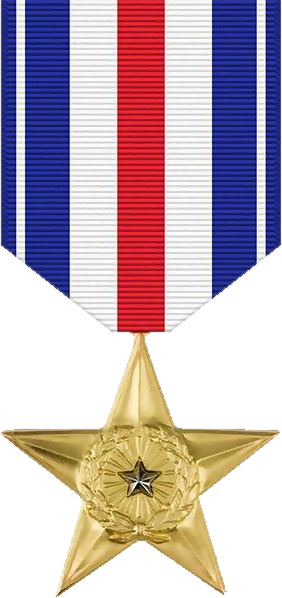
Silver StarSilver StarSilver Star

Silver Star


Share Link: http://pmc.widener.edu/pmc/legacies/cadets/thomas-anderson-42-four-time-silver-star-leader-two-wars 
Walter Layer
Class of 1932

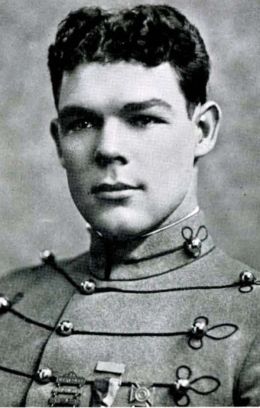
Walter F. Layer ’32: Service, Leadership, and Distinguished Alumni

"Walt” Layer entered PMC in 1928 after attending Pennsylvania Military Preparatory School. As a cadet he was admired by all and earned the confidence of General Charles E. Hyatt. Academically he was a serious student and earned a degree in Civil Engineering. Athletically he was talented and captained the football, baseball and boxing teams. He also won a letter in basketball. George Hansell, former PMC Athletic Director said “No man ever had a greater love for the college and its athletic program than Walt.”

After graduation he taught mathematics at PMC for two years. He resigned his commission in the Army Reserve in 1941 and accepted a commission in the Marine Corps Reserve. During World War II, he served in both the European and Asiatic theatres. After the war he served in the state legislature and as a councilman for the borough of Ridley Park. In 1950, Layer was recalled to active duty and commanded the 1st Marine Regiment in Korea. In 1953 he was integrated into the regular Marine Corps. His next assignments were as Provost Marshal of the Navy Department and commanding officer of the Marine Corps Barracks, Brooklyn Navy Yard.

In 1965 Layer was awarded the Outstanding Alumnus Award that was presented posthumously. The citation read in part: “The purpose of the award is to honor a graduate who has … brought recognition and distinction to his Alma Mater and himself.” Cadets formed an honor guard for Colonel Layer’s funeral before his burial in Arlington National Cemetery.

Share Link: https://pmc.widener.edu/pmc/legacies/cadets/walter-f-layer-32-service-leadership-and-distinguished-alumni 

Eugene L. Melchoir
Class of 1949

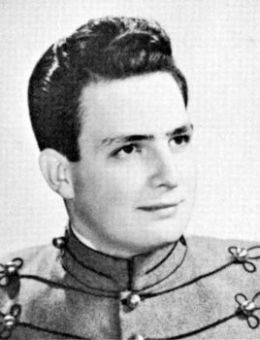
Eugene L. Melchoir ’49: PMC’s First Korean War Casualty

Eugene L. Melchoir Eugene L. Melchoir As a senior, “Midge” Melchoir was the Battalion Adjutant, business manager for the Sabre & Sash and a member of the Glee Club. At Commencement, he was commissioned a second lieutenant, began active duty immediately, and volunteered for paratrooper duty at Ft. Benning, GA. During his final jump, he broke his leg and was forced to transfer to the infantry. He was then flown to Korea as an officer replacement in the 1st Cavalry Division.

Melchoir arrived in Korea in September (1950) and was immediately assigned to lead a platoon in Company G. His new command was comprised of South Korean soldiers with only one Korean who could speak English. Melchoir made him his sergeant. As the Army was pushing toward the 38th parallel, the 5th Cavalry spear-headed the drive to Pyongyang. Melchoir and his platoon were constantly on the march. Although the North Koreans provided little resistance, there were numerous skirmishes.

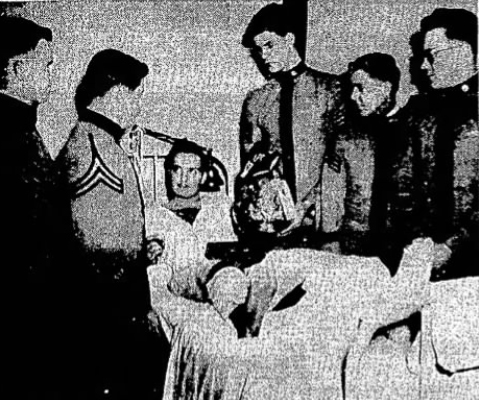
Hospital photo

After the capture of Pyongyang, the 5th Cavalry continued to push northward. While outside of Suncheon, the lead elements were attacked by a well dug in reinforced regiment. Melchoir’s platoon was ordered to take a road block, located on a ridge. During the attack, all but six members of the platoon were casualties, including Melchoir who was wounded in both legs. Despite his wounds, he continued to direct his platoon using hand and arm signals, until he was evacuated. After the attack, he was flown to Japan where he began his recovery. Several weeks later, he was flown to the Valley Forge Hospital where he received months of treatment. In March 1951, Melchoir was awarded the Silver Star (click here to read more) for his gallant actions and inspirational leadership. After spending 2 years in Veterans Hospitals, he was discharged.

Melchoir worked for the Hercules Powder Company, a small explosives company serving the mining industry, gun owners, and the military, for 6 years. He left Hercules to become the owner and operator of Midge’s Bar in Kennett Square for 35 years. Melchoir died at the Neighborhood Hospice in West Chester, PA., at the age of 84.

Military Honors & Valor

Silver Star2nd Battalion, 5th Cavalry Regiment, 1st Cavalry Division, USAFE
Silver Star for conspicuous gallantry in action near Suncheon, Korea. While proceeding along the main supply route to Suncheon, Korea. Elements of the 2nd Battalion were fired upon by a well dug-in-in reinforced regiment. Company G, the Korean platoon, moved out commanded by Lt. Melchoir. They immediately encountered a hazardous barrage of enemy mortar, automatic weapons and small arms fire, inflicting significant causalities. Being unable to speak the Korean language, Lt. Melchoir successfully overcame the language barrier by constantly exposing himself to the deadly fire of the enemy to indicate to his men their mission, and while directing their fire by using hand and arm signals. During this action, Lt. Melchoir was wounded in both legs but still courageously continued to direct his platoon until he was evacuated. His selfless and courageous actions prevented a well-planned ambush from inflicting higher losses on his platoon and disrupting the mission.

Share Link: http://pmc.widener.edu/pmc/legacies/cadets/eugene-l-melchoir-49-pmcs-first-korean-war-casualty 

George Bjotvedt
Class of 1951

George Bjotvedt ’51: Leading Scout Dog Patrols in Korea

George Bjotvedt arrived at PMC in the fall of 1947. The transformation to cadet #224 began when the college tailor fitted him for his uniform. That year freshmen were assigned to Old Main where a cadre of senior cadets enforced the rules and regulations. By his junior year, cadet life was “second nature,” and he realized the structure was preparing him for the future. He was a Distinguished Military Student and upon graduation received a regular army commission. Like many of his classmates he would be asked to perform as a leader of men in combat during the Korean War.

When he arrived in Korea, he was transported to the 65th Puerto Rican Regiment. There he was assigned to A Company of the first battalion. Bjotvedt soon found himself conducting the bulk of ambush patrols for the battalion. At first the men of the 65th Puerto Rican Regiment suffered numerous casualties while patrolling in “No-Man’s Land.” To make these dangerous assignments more manageable, a scout dog and handler were assigned to each patrol.

German Shepherds were used because of their temperament, size, and toughness. Bjotvedt described these dogs as being able to “detect hidden enemy far in advance of the patrol’s ability to see, hear or smell the enemy.” When a scout dog sensed the enemy he would alert the patrol, “much like a bird dog’s rigid stance.” Each night a patrol, following a predetermined route and position, would advance into “No-Man’s Land” escorted by a scout dog. The patrol would advance in single file with the scout dog clearing the way. The patrol relied on the dog’s night vision and keen hearing throughout the patrol.

Many thankful soldiers will remember the outstanding service of the scout dogs.

Share Link: http://pmc.widener.edu/pmc/legacies/cadets/george-bjotvedt-51-leading-scout-dog-patrols-korea