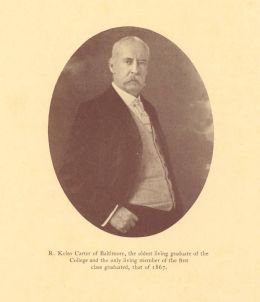
Russell Kelso Carter ’67: Educator, Hymn Writer, and PMA Pioneer
Russell Kelso Carter was born on November 18, 1849, and grew up in Baltimore, Maryland. He was a member of Pennsylvania Military Academy’s first graduating class in 1867 and was one of the first cadets to graduate with a degree in Civil Engineering.
As a student, Carter was a star athlete-said to be “one of the cleverest of the early pitchers” on the school’s first baseball team (formed in 1866) and an expert gymnast excelling in routines with a pair of 20-pound Indian clubs.
Carter remained at PMA after his graduation, where he taught Natural Sciences and Chemistry until 1872. After the 1873 commencement exercises, graduates met at the Continental Hotel in Philadelphia to form an Alumni Association so that “the friendships of former years might be preserved, the more agreeable memories cherished, and a spirit of union and good fellowship fostered.” Captain Carter, as he was known, was elected its first president. He first served in this post from 1873 to 1874, then again from 1878 to 1879.
Ill health forced him to move to California for three years, but he returned in 1876 to resume duties as Professor of Mathematics and Tactics Instructor. In 1878, Carter developed a course that warranted the conferring of a degree in Chemistry. After the retirement of Col. George Patton, who organized PMA’s engineering program in 1864, Carter was made Professor of Engineering in 1881. He immediately set out to improve the Civil Engineering program and introduced practical aspects to the program and new textbooks for mathematics, and he expanded the survey program. But in the summer of 1887, he again became ill and was forced to resign from the faculty of PMA. He moved to New Jersey to recover.
After resigning from PMA, Carter became an ordained Methodist minister and then a physician in Baltimore, Maryland. During his many career changes, Carter wrote prolifically on religion, mathematics and science. Of the major works published by R. Kelso Carter, at least five books were about holiness and faith healing, seven about Christianity and science, one about medicine, one about missions, three were hymnals, and four were novels. In Hymns of the Christian Life published in 1891, Carter wrote the words and music for 52 hymns, the music for 44 hymns by other writers, and adapted music for 25 other hymns. The most beloved hymn written by R. Kelso Carter is “Standing on the Promises,” contained in the 1885 hymnal, Songs of Perfect Love, edited by PMA music professor John R. Sweeny.
During the summer of 1892, Carter returned to California while his family remained in Maryland. A short time later, he filed for divorce from his wife. After successful medical treatment of tuberculosis (“consumption”), he distanced himself from faith healing, returned to Baltimore, studied medicine and became a physician. He practiced in the Baltimore area until his death on August 23, 1928. His obituary noted that he had been the last surviving alumnus of PMA.
Today, Widener University continues to honor Carter by bestowing the R. Kelso Carter Award each year on a U.S. citizen (other than a graduate of PMC or Widener) who "in the opinion of the Alumni Association, has through acts and accomplishments brought honor to the college.
“Standing on the Promises” is still sung, as you can hear in this modern rendition: https://www.youtube.com/watch?v=QVeHDun_oEQ&t=10s.
Share Link: http://pmc.widener.edu/pmc/legacies/cadets/russell-kelso-carter-67-educator-hymn-writer-and-pma-pioneer